


Writing Through the Night: Atefe Asadi and Daniela Dröscher Publish 'Schreiben ist Nacht'

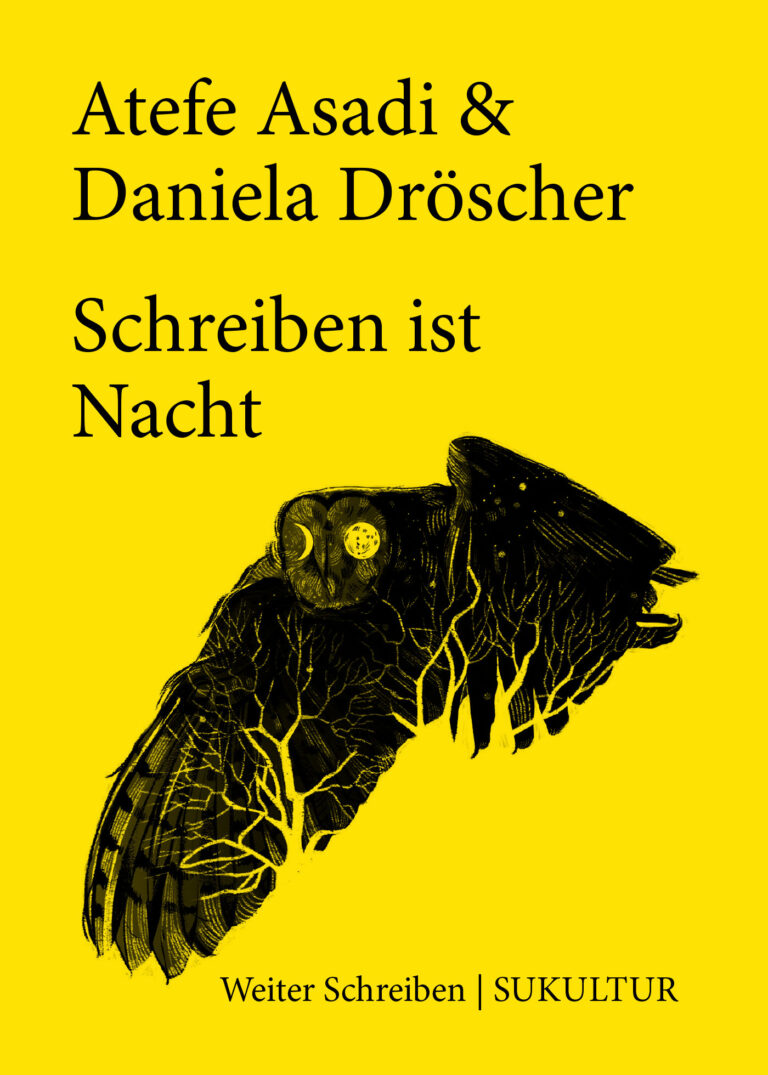
Iranian writer Atefe Asadi, a former ICORN resident in Hannover, and German author Daniela Dröscher have published 'Schreiben ist Nacht' (‘Writing Is Night’), a book of literary correspondence exploring language, memory, friendship, the experience of displacement, and the act of writing across borders.
Published by Berlin-based SUKULTUR in May 2026, Schreiben ist Nacht grew out of the Weiter Schreiben programme, an initiative that connects writers from countries affected by war, censorship, or persecution with German-speaking authors in long-term literary collaborations. What began as a shared writing project on the theme of ‘night’ gradually evolved into an exchange of twelve letters, in which Asadi and Dröscher reflect on literature, language, censorship, migration, friendship and belonging.
The book received its first public presentation on 1 July 2026 at the Deutsches Literaturinstitut Leipzig, where Atefe Asadi and Daniela Dröscher introduced excerpts from their correspondence in a public reading and conversation, offering audiences an early glimpse into the dialogue that later became Schreiben ist Nacht.
Although Asadi continues to write primarily in Persian, Schreiben ist Nacht marks the first standalone book publication of her work in German, opening a new chapter in her dialogue with German-speaking readers:
‘Beginning a literary life in a new country is never easy. In many ways, it feels like starting from zero, especially when you continue to write in your own language while living in another. That is why this small book means so much to me. It marks my first step into the German literary landscape, and for that reason it feels deeply symbolic. I hope it will be the beginning of many more conversations, collaborations and encounters with German-speaking readers.’
Although Asadi and Dröscher come from different literary traditions, their correspondence is not an attempt to erase differences or reach simple conclusions. Instead, the letters embrace curiosity, attentive listening and mutual trust, revealing how literature can become a meeting place between distinct histories and perspectives.
Translation is an essential part of the creative process. Written in Persian and German, every letter crossed linguistic boundaries before reaching its recipient. Translation is therefore not simply a technical necessity but an act of collaboration, allowing the conversation itself to unfold across languages.
Since completing her ICORN residency, Asadi has expanded her literary collaborations, published new work, participated in literary festivals and public conversations, and continued writing in dialogue with readers and fellow authors across languages. The publication of Schreiben ist Nacht marks an important milestone in that ongoing journey.
The book also reflects one of ICORN's central commitments: supporting writers not only by providing a place of safety, but by creating the conditions in which literature can continue to grow. Schreiben ist Nacht stands as an example of how international literary collaboration can flourish when writers are able to work freely across borders.
Moving between the personal and the political, Schreiben ist Nacht invites readers into a conversation that crosses languages, histories and borders. The correspondence explores not only what it means to write across experiences of displacement, but also how friendship, translation and sustained dialogue can become creative responses to division and isolation.
You can buy the book here.
***
This article was written by Atefe Asadi.

