


Two million Norwegian kroner for a film about cartoonist Ali Dorani, aka Eaten Fish

In June 2026, the Norwegian Film Institute awarded two million Norwegian kroner towards the production of the documentary film Eaten Fish about award-winning cartoonist and former ICORN resident in Stavanger, Ali Dorani.
After spending almost five years in an Australian refugee detention camp on Manus Island in Papua New Guinea, Ali Dorani arrived in Stavanger as the city's 11th ICORN resident.
What happens to a person after years of detention? In his new homeland of Norway, far from his family and the war in Iran, Ali continues to battle the scars of his captivity. These are some of the issues explored by director Daniel Nils Roberts and producer Anne Köhncke in the documentary Eaten Fish.
Ali Dorani is an award-winning satirist from Iran, known by the pseudonym Eaten Fish. He arrived in Stavanger in 2017 as the city's ICORN resident after spending almost five years in an Australian refugee detention camp on Manus Island, Papua New Guinea.
The consequences of an inhumane refugee policy
In 2012, the Australian authorities decided that individuals arriving in Australia by boat would be placed in refugee camps in third countries. The policy came into effect in 2013. Unaware of this change, Dorani left Iran in 2013 and arrived by boat on Christmas Island on 6 August of that year, where he sought asylum. He adopted the pen name Eaten Fish after being rescued at sea on his journey to Australia.
Dorani was transferred to Manus Island in January 2014, where he was detained in prison-like conditions. Through his drawings, he began documenting the difficult conditions asylum seekers faced and the poor treatment they received on Manus Island. His cartoons were subsequently published by The Guardian, The Washington Post, ABC News, New Matilda, and Law Text Culture. Dorani's work gained international recognition for its depiction of life inside the detention centre on Manus Island.
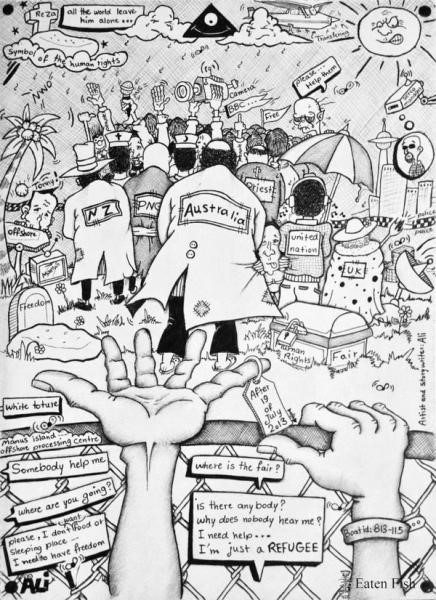
This attention led to support from numerous individuals and organisations advocating for Dorani's release and fair treatment. Among them were Cartoonists Rights Network International (CRNI), fellow cartoonists, and international human rights organisations.
In 2016, Dorani received CRNI's Award for Courage in Editorial Cartooning for documenting abuses of power and harassment in the Manus Island detention centre.

Life after the refugee detention camp
In his new homeland of Norway, far from his family and the war in Iran, Ali still struggles with the scars of his captivity. He has spoken openly about how his years on Manus Island left him with severe OCD and PTSD.
In the new documentary, past and present merge as Dorani leads a team of artisans in building life-sized versions of his drawings. His art was once a path to freedom. Can he now use it to finally put the past behind him?
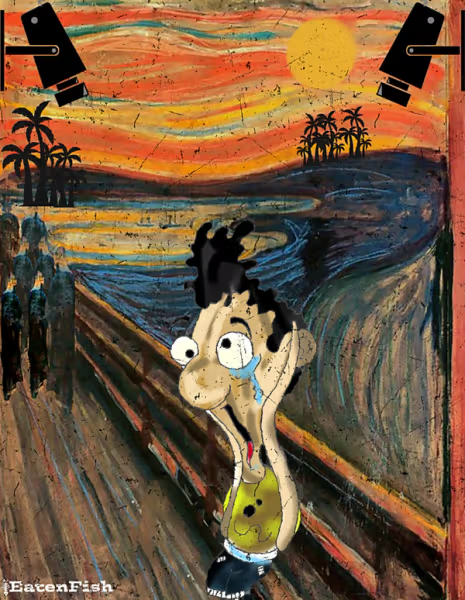
In its funding decision, NFI film consultant Anna J. Ljungmark made the following statement about the project:
‘In a film that intertwines the protagonist's drawings, three-dimensional models, animation embedded in everyday life, and live action, a story of healing is told. It sheds light not only on the trauma experienced by the protagonist, but through its form also provides a deeper understanding of what it is like to live with PTSD and OCD. The project radiates creativity through the collaboration between the director and the protagonist. It is a unique and relevant story, told through an innovative cinematic language and produced with both care and professionalism.’
In addition to support from the Norwegian Film Institute, the production has also received funding from ARTE France, Filmkraft Rogaland, Viken Filmsenter, the Fritt Ord Foundation, and SVT.

