


'Not just a project, but a part of the city’s heart': Malmö’s 15 years as an ICORN City of Refuge
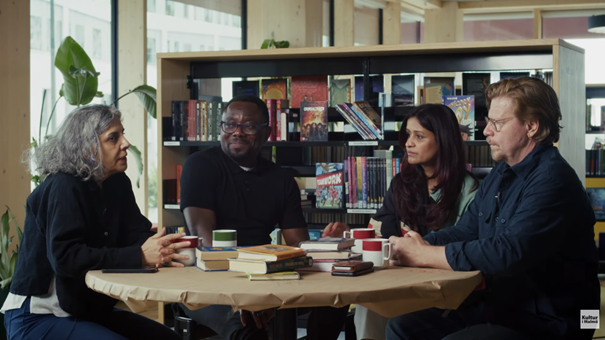
In 2025, Malmö celebrates 15 years as an ICORN City of Refuge. To mark the anniversary, the City of Malmö has produced the documentary film ‘En fristad i staden’ (A Sanctuary in the City). The documentary is a 28-minute journey through Malmö’s role as a City of Refuge for free expression. The film centres around the stories and work of writers, artists, and journalists who have found safety and the ability to continue their work in Malmö through its ICORN Programme.
Directed by Jude Dibia, narrated by Rida Khan, and filmed and edited by Diego Monsiváis García, the documentary was produced by Malmö’s Cultural Administration. It features interviews with current and former ICORN residents reflecting on freedom, exile, belonging, and the power of art and journalism as forms of resistance.
Annika Cedhagen, Director of the Cultural Administration, congratulated Malmö and its residents on the anniversary, reaffirming the city’s commitment to protecting and promoting free expression.
Journalist Wali Arian, originally from Afghanistan, shared how Malmö transformed his family’s life. He also spoke about his ongoing journalistic work reporting on Afghanistan, serving old and new audiences, including the Afghan community in Sweden.
For Iranian journalist, poet, and writer Naeimeh Doostdar, who now calls Malmö her home, freedom is non-negotiable: ‘It’s the most important thing in my life, the only thing I could die for. It starts with knowing yourself, being free from others’ limitations, and reaching your full potential.’
Iraqi-Kurdish writer and activist Helan Ciya, currently in ICORN residence, reflected on the challenges of exile, including learning new cultural codes and a new language, while writer Jude Dibia recalled his enthusiasm to contribute as an artist and become part of Malmö’s community.
Egyptian musician and composer Yasmine El Baramawy shared her thoughts on the role of art as resistance, emphasising he inseparable link between art and politics: ‘When art doesn’t talk about politics, it still talks about politics.’
Afghan journalist Mukhtar Wafayee described how Malmö gave him the freedom to write without fear, be a journalist without censorship, and go to work without having to plan an escape.
Interview with Jude Dibia
Jude Dibia, an award-winning author and equal rights activist from Nigeria, was the ICORN resident in Malmö between 2015 and 2017. Today, he is the city’s ICORN coordinator and the director of the documentary film En fristad i staden, celebrating Malmö’s 15 years as an ICORN City of Refuge
In this interview, Dibia reflects on the professional and personal significance of directing the film and the future of Malmö as a City of Refuge.
ICORN: What was it like to capture the story of Malmö is an ICORN City of Refuge on film?
Jude Dibia: Filming Malmö’s journey as an ICORN City of Refuge felt like both a responsibility and a gift. It meant creating space for voices that are often pushed to the margins—allowing them to speak, in their own words, within a city that has chosen to protect artistic freedom. It was also deeply moving: to witness the quiet persistence of those who’ve had to leave everything behind, and to see how Malmö, in its imperfect but sincere way, has opened its doors. This film isn’t just about a programme—it’s about the human decision to safeguard freedom, especially when it’s under threat.
ICORN: As Malmö’s ICORN coordinator, and as a former ICORN resident yourself, what does this project and the 15th anniversary of Malmö City of Refuge mean to you personally?
Jude Dibia: This project carries deep personal weight. To have once arrived in Malmö seeking safety—and now, years later, to be part of helping others find that same safety—feels like a circle completing itself. The 15th anniversary is more than a milestone; it’s a moment to pause and reflect. Sanctuary is not a static concept—it’s a living relationship between a city and those it chooses to protect. It speaks to Malmö’s willingness to act, and to the resilience of the artists who’ve found their footing here, however briefly. For me, it’s a quiet reminder of what it means to survive—and to be received.
ICORN: What do you hope Malmö’s population, as well as people across Sweden and beyond, will take away from this film?
Jude Dibia: I hope it opens a door to deeper understanding. That offering refuge isn’t only about compassion—it’s about standing together in defence of shared values. The film makes clear that freedom of expression isn’t abstract or distant—it’s lived, it’s fragile, and it’s vital. And I hope viewers see that when Malmö supports threatened artists, it’s not just helping someone else—it’s affirming its own democratic promise.
ICORN: What awaits Malmö as an ICORN City of Refuge over the next 15 years?
Jude Dibia: The next 15 years will require both vision and resolve. As the global landscape shifts—and threats to democracy and artistic freedom grow more complex—Malmö’s role as a sanctuary city will become even more essential. We’ll need to go beyond offering shelter, and invest in creative platforms, long-term inclusion, and cultural dialogue. Malmö has already shown what committed leadership looks like. The task ahead is to sustain that commitment, and to keep renewing it—so that sanctuary isn’t just a place, but a way of being in the world.
And yet, I hope that in 15 years' time, the very need for sanctuary cities will have faded—because the world will have grown safer, kinder, and more just. A world where artists, writers, and journalists no longer need to flee in order to speak freely. That remains my deepest wish.
Malmö’s ICORN residents
Since 2010, Malmö has hosted 11 writers, artists, and journalists in ICORN residence, including:
Parvin Ardalan is a journalist and civil rights activist from Iran. She was awarded the Olof Palme Prize in 2007 for her women’s rights activism in Iran. Ardalan was Malmö’s first ICORN resident in the period 2010-2012.
Naeimeh Doostdar is a journalist, poet and prose writer from Iran. She has published multiple collections of poetry and short stories, translated in various languages, including Swedish. Doostdar was the ICORN resident in Malmö between 2012-2014.
Ramy Essam is a musician and activist from Egypt. Performing at Tahrir Square in Cario during the Arab Spring, he has been called the ‘the man who "provided the soundtrack to the Egyptian revolution’. He was the third ICORN resident in Malmö (2014-2016), and the first musician to be hosted by the city, in close collaboration with Freemuse.
Jude Dibia is an author and equal rights activist from Nigeria. He is the author of internationally acclaimed novels and short stories, including his debut novel, Walking with Shadows, at a time when the rights and freedoms of LGBTQI+ persons in Nigeria were under intense scrutiny. In 2014, Nigeria criminalised homosexuality and Dibia made the decision to leave the country. He was in ICORN residence in Malmö between 2015 and 2017 and is now the ICORN coordinator in the city.
Wali Arian is a television journalist from Afghanistan. Reporting on the systematic human rights abuses committed by the Taliban, he faced persecution and threats to his life. Arian was the fifth ICORN resident in Malmö between 2017 and 2019.
Mukhtar Wafayee is an award-winning journalist, writer, and poet from Afghanistan, whose work focuses on security, social issues, and politics, leading him to face constant threats and harassment. He was the ICORN resident in Malmö in the period 2019-2020.
Yasmine El Baramawy is a musician, composer, sound designer, political and women’s rights activist. As one of the women who was assaulted during the 2012 Egyptian protests, Yasmine’s life and musical career were severely affected after she spoke out about her experiences. She was in ICORN residence in Malmö between 2020-2022.
Keywan Karimi is an Iranian filmmaker whose work explores a range of social and political issues that plague his homeland and region. He was Malmö’s eight ICORN resident during the period 2021-2022.
Azhar Al-Rubaie is a journalist, researcher, and writer from Basra, Iraq. He has contributed to pan-Arab and international media outlets including the BBC, Deutsche Welle, The Telegraph, Al Jazeera, Middle East Eye, VICE, TheArab Weekly, The New Arab, and Raseef22. Between 2023 and 2025, Al-Rubaie was the ICORN resident in Malmö.
Hêlan Çiya is an Iraqi-Kurdish writer, independent journalist, and a women’s rights activist. She has published her work in both print and online newspapers and magazines, being one of the few independent journalists in the region.

